Real decks follow the first half of the Sequoia pitch deck template and drop much of the second, and only 15 of 175 come within one section of its full list. Problem, solution, market and team each appear in 74% to 91% of real decks, in roughly Sequoia's order. Why now shows up in 34% of decks and financials in 17%. Traction, a slide in 70% of decks, isn't one of Sequoia's ten headings.
The template comes from Sequoia's guide Writing a Business Plan, by Team Sequoia. It lists ten sections, in this order:
- Company purpose
- Problem
- Solution
- Why now?
- Market potential
- Competition / alternatives
- Business model
- Team
- Financials
- Vision
How I counted
In November 2026 I checked that list against the 175 decks in the library with a full slide list. A deck counts for a section if it has at least one slide of it before any appendix. The section matching is mine, done from slide labels, and a slide can do two jobs at once. Every reviewer note I quote comes from Liam Gill or TechCrunch's Haje Jan Kamps, so it's their taste.
Sequoia's ten sections in real decks
Solution is the Sequoia section real decks use most, in 91% of them, and financials the one they use least, at 17%. I matched Sequoia's sections to the library's slide sections. "Median slide" is where the section first appears in the median deck that has one, the same numbers as the page on pitch deck slide order. The stage columns split decks into pre-seed and angel (63 decks) and seed (112 decks), and the pre-seed pitch decks and seed pitch decks have a page each.
| Sequoia section | Share of decks | Median slide | Pre-seed and angel | Seed |
|---|---|---|---|---|
| Company purpose | not counted | |||
| Problem | 83% | 3 | 87% | 80% |
| Solution | 91% | 4 or 5 | 95% | 89% |
| Why now? | 34% | 4 or 5 | 30% | 37% |
| Market potential | 74% | 6 | 84% | 69% |
| Competition / alternatives | 54% | 10 | 60% | 50% |
| Business model | 44% | 9 | 46% | 43% |
| Team | 90% | 10 | 94% | 88% |
| Financials | 17% | 13 or 14 | 17% | 17% |
| Vision | 54% | 3 | 59% | 52% |
I left company purpose out. Sequoia's instruction for it is "Start here: define your company in a single declarative sentence." Almost every deck has a cover slide (98%), but a cover isn't always a purpose statement, and the library's labels don't say which covers carry one. The reviewer notes show both kinds. Giddy's cover was praised for "a good one-liner". Keyway's was marked down: "This opening slide is missing a one-liner."
Vision needs a note too. The library's vision section holds mission, summary and recap slides as well as five-year visions, which is why its median slide is 3. Of the 95 decks with one, 43 put it only in the first half of the deck, 24 only in the second half, and 28 in both. So a closing vision slide, the way Sequoia places it, is rarer than 54% suggests.
The order mostly matches. Problem, solution, why now and market come first in both. Real decks put the business model (slide 9) slightly before competition (slide 10), where Sequoia has it the other way round. Team sits around slide 10 in both.
Sequoia sections real decks skip
145 of 175 decks have no financials slide, the Sequoia section real decks skip most often. The share is about the same at pre-seed and seed. Sequoia half expects this, since its line under Financials reads "If you have any, please include." The few that do show projections don't get much credit for them. Reviewers praised 3 financials slides and criticised 5. Supliful's projections got "Ugh, that's not an operating plan." Queerie's multi-year financials got "This is not a startup."
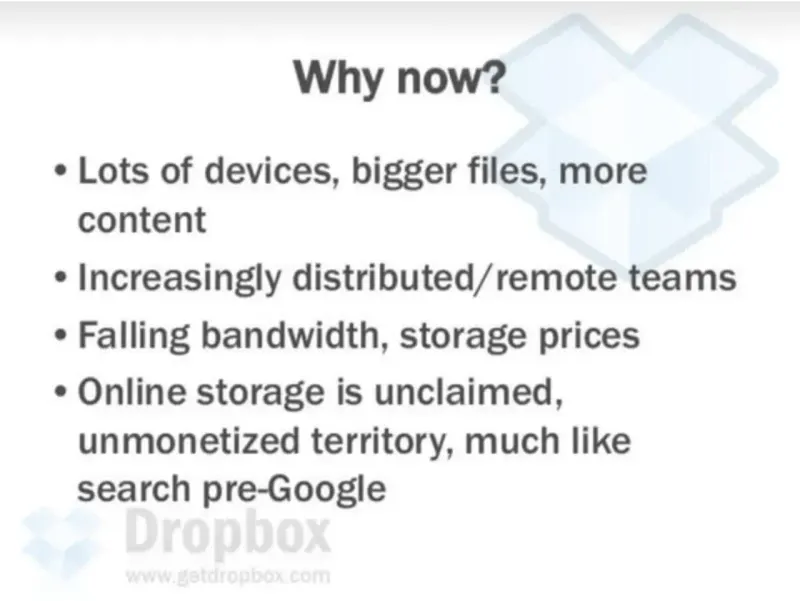
Why now comes next, with 115 decks skipping it, and it's the one Sequoia section where the reviewer notes push the other way. Reviewers praised 16 why now slides and criticised 6. The note on Dropbox's why now slide: "An overlooked slide. […] You need to explain why now so that they understand this is a company with a window of opportunity." On Supercast's "Why now? The podcast industry is booming.", the note said "This is the type of Why Now that investors look for". Krew folded it into the problem slide, and the reviewer would have split them: "separating them would make the deck more powerful."
The business model and competition slides are close to a coin flip. 98 decks have no business model slide, and 81 have no competition slide.
169 of these 175 decks raised their round, so this shows what funded decks looked like. It can't tell you which sections made them work.
Slides real decks add to the Sequoia template
Traction is the biggest addition, in 70% of decks, and Sequoia's list has no heading for it. Six sections show up often in real decks that Sequoia's list doesn't name.
| Section | Share of decks | Median slide | Pre-seed and angel | Seed |
|---|---|---|---|---|
| Product | 86% | 6 | 84% | 88% |
| Traction | 70% | 8 | 65% | 72% |
| Closing (contact, thanks) | 65% | 14 | 70% | 62% |
| Ask | 42% | 14 | 48% | 39% |
| Roadmap | 37% | 13 | 35% | 38% |
| Go-to-market | 35% | 10 | 24% | 41% |
Product and traction are the big ones. Sequoia's solution section asks where the product goes next, so a product slide fits under it. Traction has no home in the template at all. Real decks put it at slide 8, between market and business model. The note on Tulipshare's "What we achieved in 5 months" slide: "This is a slide that is often missing. You need to show where you've come from."
Go-to-market is the one with a clear stage split. 24% of pre-seed and angel decks have one, against 41% of seed decks.
How many decks follow the full Sequoia template
The median deck covers 6 of the 9 Sequoia sections I could count, leaving purpose aside. One deck of 175 has all nine: MiO Marketplace, an angel deck that raised $550K in 2023. 14 more have eight of nine, and 8 of those 14 are missing only why now. So 15 decks, about 9%, come within one section of the template.
If you count every cover as a purpose statement, which is generous, MiO Marketplace has all ten and 42 decks have at least 8 of 10. Every deck compared here is in the library of real pitch deck examples, slide by slide.
Airbnb's deck against the Sequoia template
The 2008 AirBed&Breakfast deck covers 7 of Sequoia's 10 sections, if you count the line on its cover as the purpose. Sequoia's page opens with Airbnb, whose founders came across this guide while they were putting their deck together. The library's copy has 14 slides and comes from a breakdown by Liam Gill of Persuade & Raise. Two versions with different numbers circulate, and Airbnb released neither.
| Sequoia section | AirBed&Breakfast deck |
|---|---|
| Company purpose | Slide 1: "Book rooms with locals, rather than hotels." |
| Problem | Slide 2 |
| Solution | Slide 3 |
| Why now? | No |
| Market potential | Slides 4 and 5 (market validation, market size) |
| Competition / alternatives | Slides 9 and 10 |
| Business model | Slide 7 (a 10% commission) |
| Team | Slide 11 |
| Financials | No. Slide 14 is titled "Financial", but it's the ask |
| Vision | No |
The reviewer's note on the cover: "the first slide told them exactly what AirBnB did." On top of those sections, the deck has a product slide, an adoption strategy slide (events, partnerships, Craigslist), two traction slides (press and user testimonials) and the ask. The ask reads "12 months financing to reach 80,000 transactions ($500K angel round)".
The $500K angel round this deck asked for didn't close in 2008, which is why the library files it as a failed raise. A seed of about $600K from Sequoia followed in April 2009. Nothing in the library says which version of the deck, if any, Sequoia saw.
How I'd use the Sequoia template
- Keep the first half as it is. Problem, solution, market and team are in 74% to 91% of real decks, in close to Sequoia's order.
- Add a traction slide around slide 8 if you have anything to show. 70% of decks do, and it isn't on Sequoia's list.
- Write the why now slide. Only a third of decks have one, and reviewers praised it far more often than they criticised it.
- Skip the financials slide at pre-seed unless you have real numbers. 83% of decks skip it, and Sequoia's own wording makes it optional.
- Put a one-line description of the company on the cover, the way Airbnb did.
- Close with the ask. Sequoia's list ends at vision, but 42% of real decks state how much they're raising, usually near the end.
If you're also deciding on length, I counted that in how many slides a pitch deck should have.
The traction slide I'd copy is Tulipshare's, titled "What we achieved in 5 months" and placed at slide 8. More slides like it, each with its reviewer note, are on the traction slide examples page.