9 of the 13 famous pitch decks in this library have no ask slide, and 11 have no financials slide. They are the early decks of Airbnb, Uber, YouTube, Dropbox, Wise, Intercom, Revolut, Coinbase, Foursquare, Buffer, Notion, Loom and ElevenLabs, each from an angel, pre-seed or seed round. The median famous deck has 13 slides, the same as the library's median before any appendix. Only 6 of the 13 have all five of problem, market, competition, team and traction.
| Deck | Year | Stage | Round | Slides |
|---|---|---|---|---|
| YouTube | 2005 | Seed | $3.5M | 10 |
| Dropbox | 2007 | Seed | $1.2M | 17 |
| Airbnb | 2008 | Angel | $500K sought, didn't close | 14 |
| Uber (UberCab) | 2008 | Angel | $200K | 25 |
| Foursquare | 2009 | Seed | $1.35M | 15 |
| Wise (TransferWise) | 2011 | Seed | $1.3M | 9 |
| Intercom | 2011 | Angel | $600K | 8 |
| Buffer | 2011 | Seed | $450K | 13 |
| Coinbase | 2012 | Seed | $600K | 11 |
| Notion | 2013 | Seed | not recorded | 16 |
| Revolut | 2015 | Seed | $2.3M | 12 |
| Loom (OpenTest) | 2016 | Pre-seed | $600K | 12 |
| ElevenLabs | 2023 | Pre-seed | $2M | 14 |
Some of these rows carry caveats from the sources. YouTube's $3.5M from Sequoia is called a seed by some sources and a Series A by others. Intercom's stage is disputed. One breakdown calls it pre-seed, and other collections call it seed. Buffer's founders describe about $450K from 18 investors, though their blog headline says $500K. Notion's sources don't record an amount or a close. The Dropbox breakdown files it as pre-seed, while the round itself was a $1.2M seed.
How I counted
I went through all 13 slide by slide in November 2026, when the library had 176 decks. A deck has a section if it has at least one slide of it before any appendix, using the library's slide sections, which are matched from slide labels. Each deck page credits its source, and the reviewer notes quoted here are listed under Sources at the end.
Airbnb pitch deck: a round that didn't close
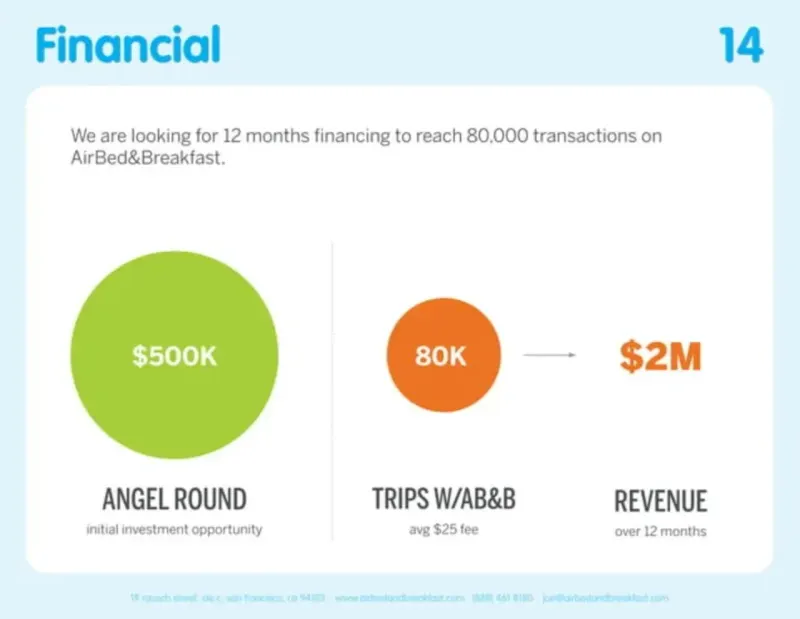
The 2008 AirBed&Breakfast deck has 14 slides and asks for a "$500K angel round" on its last slide, a round that didn't close, which is why the library lists it with the failed pitch decks. A seed of about $600K from Sequoia followed in April 2009. Two versions of the deck with different numbers circulate, and Airbnb released neither.
It has problem, market, competition, team, traction and the ask. It skips why now, vision and financials. Slide 14 is titled "Financial", but it holds the ask. Liam Gill of Persuade & Raise gave a verdict on 10 of the 14 slides, and praised all 10. The reviewer's note on that last slide: "now they don't ask for the $500k. They pitch it as a way of hitting a milestone in the next 12 months."
I compared the same deck against Sequoia's ten sections in the Sequoia pitch deck template post. Sequoia's guide opens with Airbnb's founders.
Uber pitch deck: 25 slides and no team slide
The 2008 UberCab deck is the longest of the 13, at 25 slides. 11 of them are solution or product slides, among them the concept, "1-Click Car Service", the apps, the website, the fleet, the technology, three value proposition slides. Market size doesn't come until slides 17 and 18. There is no team slide and no ask slide. It is one of only two decks here with a financials slide, a scenario slide called "Potential Outcomes".
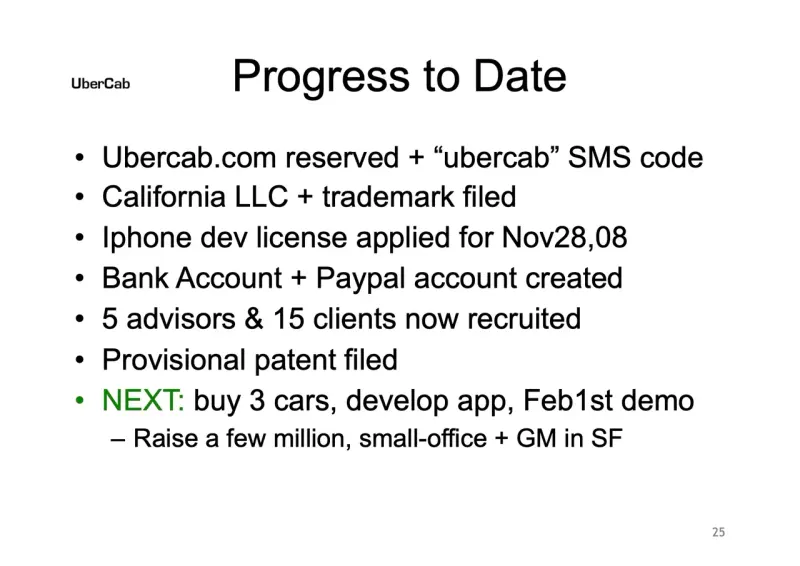
TechCrunch's Haje Jan Kamps gave a verdict on 5 slides, praising 3 and criticising 2. The why-now slide, "SmartPhones Aug 2008", got "SmartPhones. They're a thing." Traction comes last, on slide 25, "Progress to Date". The reviewer's note on that slide: "This is god-awful."
Dropbox pitch deck: three problem slides, no market slide
Dropbox's 2007 deck runs 17 slides. It spends slides 2 to 4 on the problem, has a why-now slide at slide 8, and gives competition three slides (why better, a feature grid against Carbonite, Mozy, Foldershare and box.net, and "What did they screw up?"). It has no market slide and no ask slide. The only traction is the last slide, a VentureBeat quote ranking Dropbox first among that summer's YC startups.
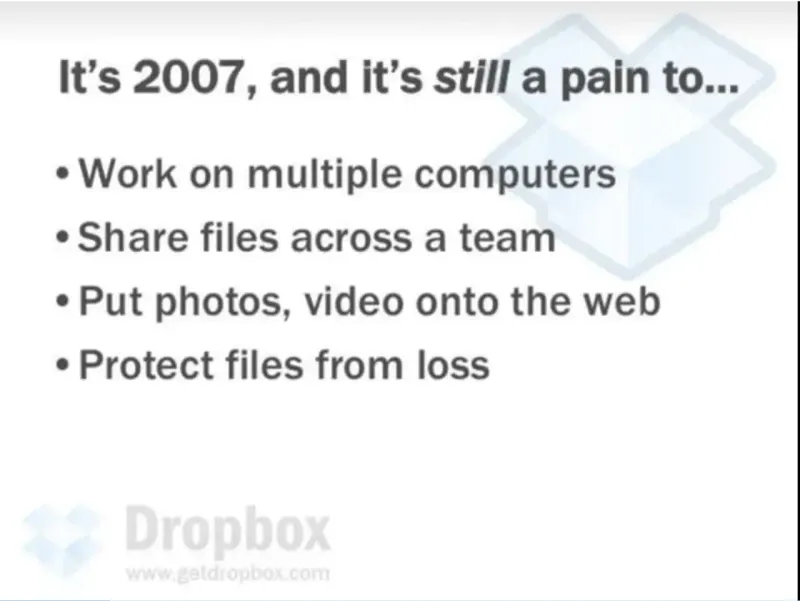
Liam Gill gave a verdict on 9 slides and praised all 9. The reviewer's note on slide 3, "It's 2007, and it's still a pain to...": "I'd always recommend at least 2 problem slides so that one can explain the problem while the other animates it."
Wise pitch deck: 9 slides, no problem slide
The TransferWise deck is dated 31 May 2011 and has 9 slides. There is no separate problem slide. Slide 2 puts the problem and the solution on one before/after slide. Traction comes at slide 4, before competition and team. There is no market slide. Slide 8 asks for 650K GBP "to last until end of 2012".
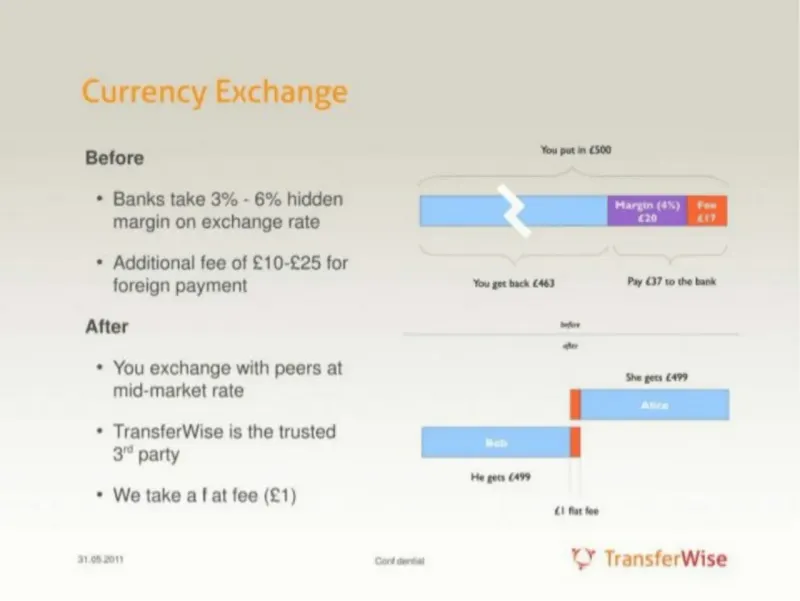
The breakdown comments on the first 5 slides and praises all of them. The reviewer's note on slide 2: "Instead of having a problem/solution slide as you traditionally have they combined them into a single slide. Framing this as a before/after works well here to demonstrate the value proposition".
Intercom pitch deck: 8 slides, team second
Intercom's 2011 deck is the shortest here, at 8 slides, and it still covers six of the seven core sections in the table below. Only financials is missing. It puts the team at slide 2, before the problem, and ends on "$600k convertible note, 18 months of runway". The one verdict in the breakdown is on the team slide: "It's not just a resume; it highlights specific skills and accomplishments that give investors the confidence to back this team."
YouTube pitch deck: a market slide with no number
YouTube's 2005 deck has 10 slides, and its titles read almost like Sequoia's list. After the cover come company purpose, problem, solution, market size, competition, product development, sales and distribution, team, metrics. The library files its market size slide as a why-now slide, because it carries no number and is really about timing. So by the labels it has no market slide. There is no ask and no financials. The deck has no reviewer notes, and the slide version's origin is undocumented. The court record holds a five-page text document, and one source puts metrics before team.
Core sections famous decks left out
Revolut is the only one of the 13 decks with all seven core sections, and Foursquare is the sparest. A tick means the deck has at least one slide of that section. The bottom row is the share for all 176 decks in the library when I counted in November 2026, these 13 included.
| Deck | Slides | Problem | Market | Competition | Team | Traction | Ask | Financials |
|---|---|---|---|---|---|---|---|---|
| Airbnb | 14 | ✓ | ✓ | ✓ | ✓ | ✓ | ✓ | |
| Uber (UberCab) | 25 | ✓ | ✓ | ✓ | ✓ | ✓ | ||
| YouTube | 10 | ✓ | ✓ | ✓ | ✓ | |||
| Coinbase | 11 | ✓ | ✓ | ✓ | ||||
| Revolut | 12 | ✓ | ✓ | ✓ | ✓ | ✓ | ✓ | ✓ |
| Dropbox | 17 | ✓ | ✓ | ✓ | ✓ | |||
| Wise (TransferWise) | 9 | ✓ | ✓ | ✓ | ✓ | |||
| Intercom | 8 | ✓ | ✓ | ✓ | ✓ | ✓ | ✓ | |
| Foursquare | 15 | ✓ | ✓ | |||||
| Buffer | 13 | ✓ | ✓ | ✓ | ✓ | ✓ | ||
| Notion | 16 | ✓ | ✓ | |||||
| Loom (OpenTest) | 12 | ✓ | ✓ | ✓ | ✓ | ✓ | ||
| ElevenLabs | 14 | ✓ | ✓ | ✓ | ✓ | ✓ | ||
| These 13 | 11 | 9 | 10 | 10 | 12 | 4 | 2 | |
| All 176 decks | 83% | 74% | 53% | 90% | 70% | 42% | 17% |
Revolut's slide 11 is "Projections & Our Ask", followed by a use-of-funds slide. 9 of Foursquare's 15 slides are product features (check-ins, points, leaderboard, tips, badges, merchant rewards), two are revenue models, and it has no problem, market or competition slide. Coinbase has no team slide, and Notion has neither team nor traction.
Against the library, these 13 have traction (12 of 13) and competition (10 of 13) more often, and team (10 of 13) and an ask slide (4 of 13) less often.
What famous pitch decks have in common
12 of the 13 famous decks have a traction slide, more than any other core section. These companies are famous because they did well later, so the decks show what their early pitches looked like. They can't show why the rounds closed.
- Length didn't set them apart. They run from 8 slides (Intercom) to 25 (UberCab), with a median of 13. If you're deciding on length, I counted that in how many slides a pitch deck should have.
- Traction is the slide they nearly all had, even when it was small. Coinbase showed "$65,000 in first 5 weeks". The note on Buffer's traction slide, from the founders' blog: "as first time founders, this was probably our only way to raise any money: By focusing everything on the traction slide."
- A missing core slide didn't stop these rounds. Foursquare raised with no problem, market or competition slide, Uber with no team slide, Coinbase with neither team nor competition.
- 9 of the 13 didn't put the ask on a slide. Of the four that do, Airbnb and Intercom tie the money to a milestone or to months of runway.
- Financials are rare here too, 2 of 13, close to the 17% across the library.
You can see where each section sits in a deck on the slide order page. The seed pitch decks and the whole set of startup pitch deck examples hold the rest of the library.
Coinbase's traction slide is the line I'd copy from these 13: "$65,000 in first 5 weeks". For decks from rounds closer to your own, browse the pre-seed pitch decks.
Sources
Each deck page credits its source. The reviewer notes quoted above come from these.
- Airbnb: Persuade & Raise (Liam Gill)
- Uber (UberCab): TechCrunch Pitch Deck Teardown, reviewer Haje Jan Kamps
- YouTube: PitchMagic
- Coinbase: PitchMagic
- Revolut: Deck PDF copy (peterfisk.com)
- Dropbox: Persuade & Raise (Liam Gill)
- Wise (TransferWise): Persuade & Raise (Liam Gill)
- Intercom: Persuade & Raise (Liam Gill)
- Foursquare: SlideShare upload
- Buffer: Founder blog (Buffer), notes by Leo Widrich
- Notion: PitchMagic
- Loom (OpenTest): startupfundraising.com teardown
- ElevenLabs: whynotfunded (HeyMojo) breakdown