A pitch deck is a short slide presentation that founders use to raise money from investors, and the median deck in this library runs 14 slides. Founders send it ahead by email so an investor can read it alone, and they show it on screen while they talk through it in a meeting. Either way its job is to explain the company quickly enough that the investor wants the next conversation. A deck rarely closes a round by itself.
How I counted
In November 2026 the library had 176 decks: 113 seed, 49 pre-seed and 14 angel. The section counts below use the 175 decks with a full slide list, and only slides before any appendix. 169 of the 176 decks raised their round, so this shows what funded decks contain. It can't tell you which sections made them work.
What a pitch deck includes
The median deck covers 10 of the library's 16 sections. I sorted every slide into one of them. "Median slide" is where the section first appears in the median deck that has one, the same numbers as the page on pitch deck slide order.
| Section | Decks | Share | Median slide |
|---|---|---|---|
| Cover | 172 | 98% | 1 |
| Solution | 160 | 91% | 4 or 5 |
| Team | 157 | 90% | 10 |
| Product | 151 | 86% | 6 |
| Problem | 145 | 83% | 3 |
| Market | 130 | 74% | 6 |
| Traction | 122 | 70% | 8 |
| Closing | 114 | 65% | 14 |
| Vision and summary | 95 | 54% | 3 |
| Competition | 94 | 54% | 10 |
| Business model | 77 | 44% | 9 |
| Ask | 74 | 42% | 14 |
| Roadmap | 65 | 37% | 13 |
| Go-to-market | 61 | 35% | 10 |
| Why now | 60 | 34% | 4 or 5 |
| Financials | 30 | 17% | 13 or 14 |
Six sections make up the core of a deck, each in at least 74% of decks. They are the cover, problem, solution, product, team and market, and they come in roughly that order, with team near the end. Fewer decks than I expected have all six together, though, only 74 of 175.
Traction sits just below the core at 70%. It is the slide where a deck shows numbers, customers or pilots.
Below half are the business model (44%), the ask (42%), the roadmap (37%), go-to-market (35%), why now (34%) and financials. Financials are the rarest, with 30 of 175 decks showing a slide of projections or budgets.
On length, the median pre-seed deck has 12 slides and the median seed deck has 14. I went into the spread and the shortest decks that raised in how many slides a pitch deck should have. If you want examples from your own stage, there are pages for pre-seed pitch decks and seed pitch decks, and the differences between the two are in pre-seed vs seed.
What a pitch deck looks like
The library's Airbnb pitch deck is the 2008 AirBed&Breakfast deck, which has 14 slides, all with images. It runs cover, problem, solution, two market slides, product, business model, adoption strategy, two competition slides, team, press, testimonials and the ask.
The cover says what the company does in one line: "Book rooms with locals, rather than hotels." The reviewer's note on that slide: "One of the things that investors loved about this deck was that the first slide told them exactly what AirBnB did."
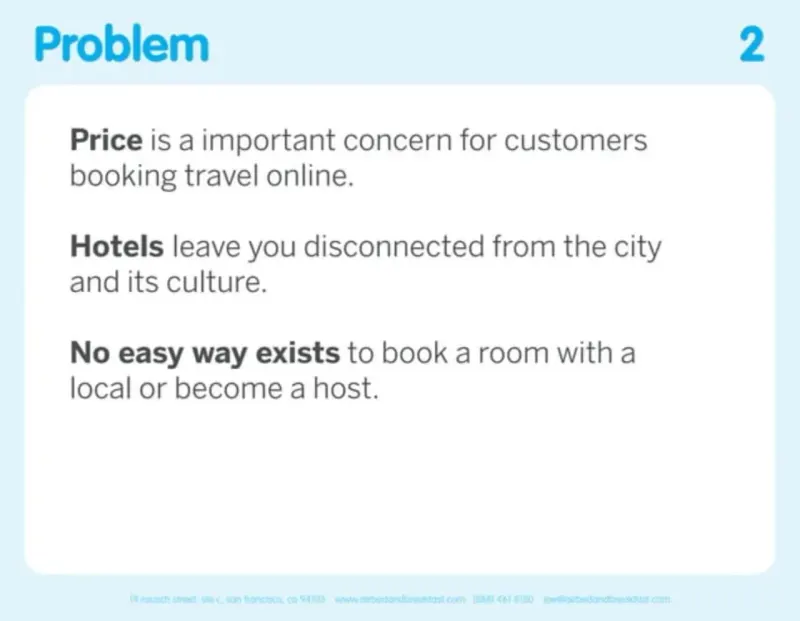
The problem comes next, as three short points.
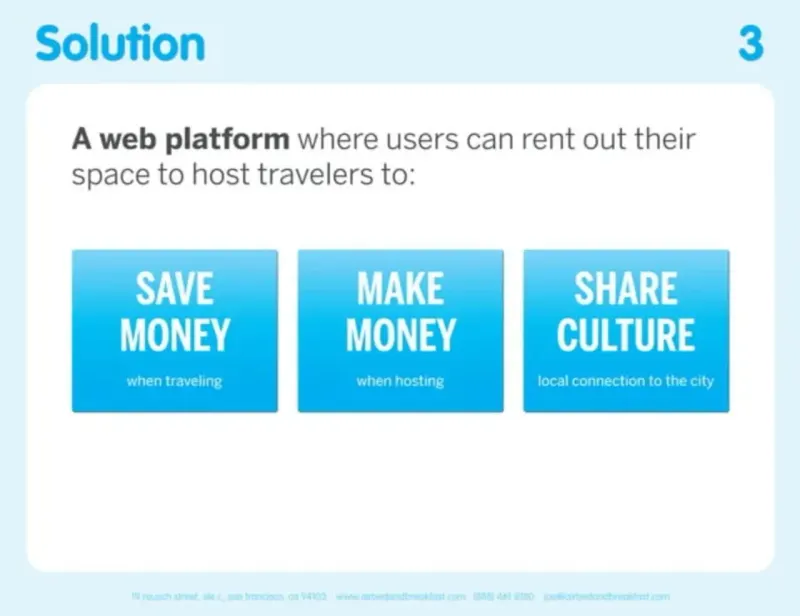
The solution names the product type: "A web platform where users can rent out their space to host travelers".
The last slide is titled Financial, but it holds the ask. It asks for 12 months of financing to reach 80,000 transactions, as a $500K angel round.
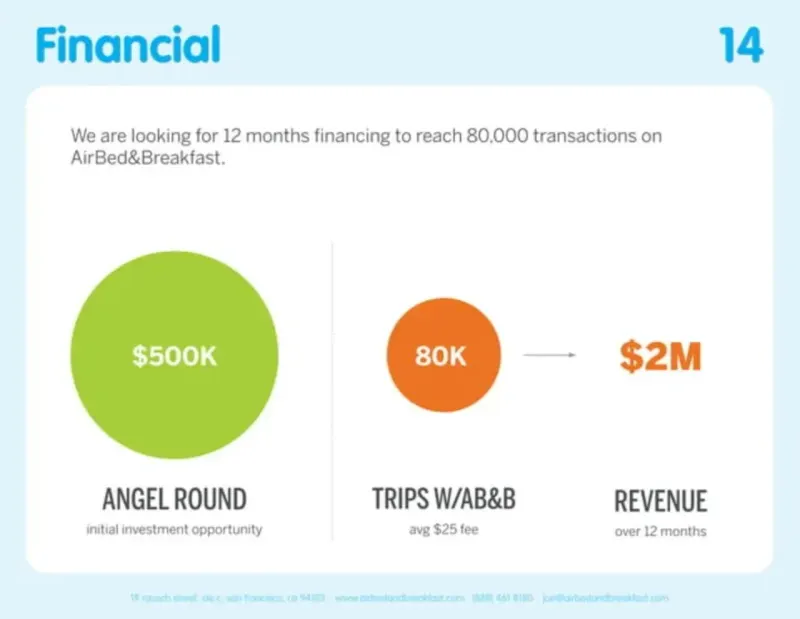
That round didn't close in 2008, which is why the library files this deck under failed pitch decks. A seed of about $600K from Sequoia followed in April 2009. Two versions of the deck with different numbers circulate, and Airbnb released neither.
Pitch deck slides reviewers criticised
Reviewers criticised 249 of the 624 slides they gave a verdict on. 578 of those 624 verdicts come from two teardown series, Persuade & Raise and TechCrunch's, so they reflect those reviewers' taste.
Some of the criticism comes from the deck's two uses. A deck sent by email has to make sense with nobody there to explain it. The reviewer's note on a DataHero slide makes the point: "This was a placeholder slide for demos during in-person / virtual meetings. There's obviously no reason to include this slide in a deck being emailed to investors."
Market slides were criticised most often, 35 times against 31 praises. Several of the criticised ones started from an industry total and claimed a share of it. The reviewer's note on Keyway's market slide: "These market slides that share massive industry numbers tend to scare away investors. It would be best if you always were working from the bottom up." I went through these in the TAM SAM SOM slide post.
Product slides came next, with 30 criticisms and 34 praises. Several notes are about slides that assume the reader already knows the field, or list features instead of telling the story. The reviewer's note on Flux's product slide: "This product slide is very unclear; it doesn't explain what the company does and relies on significant pre-existing knowledge."
Roadmaps drew 13 criticisms against 4 praises, the worst ratio of any section. The reviewer's note on The SMART Tire Company's timeline: "This isn't clear at all. Timelines should include some idea of market entry, profitability, etc. Not just testing and development (especially on a 5-year timeline)."
Problem slides drew 27 criticisms too, but 70 praises, more than any other section.
Pitch deck vs business plan
A business plan is traditionally a long written document, and a pitch deck is a short set of slides built to be read or presented in one sitting. In practice the line has blurred. Sequoia's guide is called Writing a Business Plan, and it lists 10 sections, from company purpose to vision. That is a deck outline. I checked it against the library in the Sequoia pitch deck template post.
The first line I'd copy from any of these decks is Airbnb's cover from 2008: "Book rooms with locals, rather than hotels." Every deck counted here, with each slide and reviewer note, is in the library of pitch deck examples.